

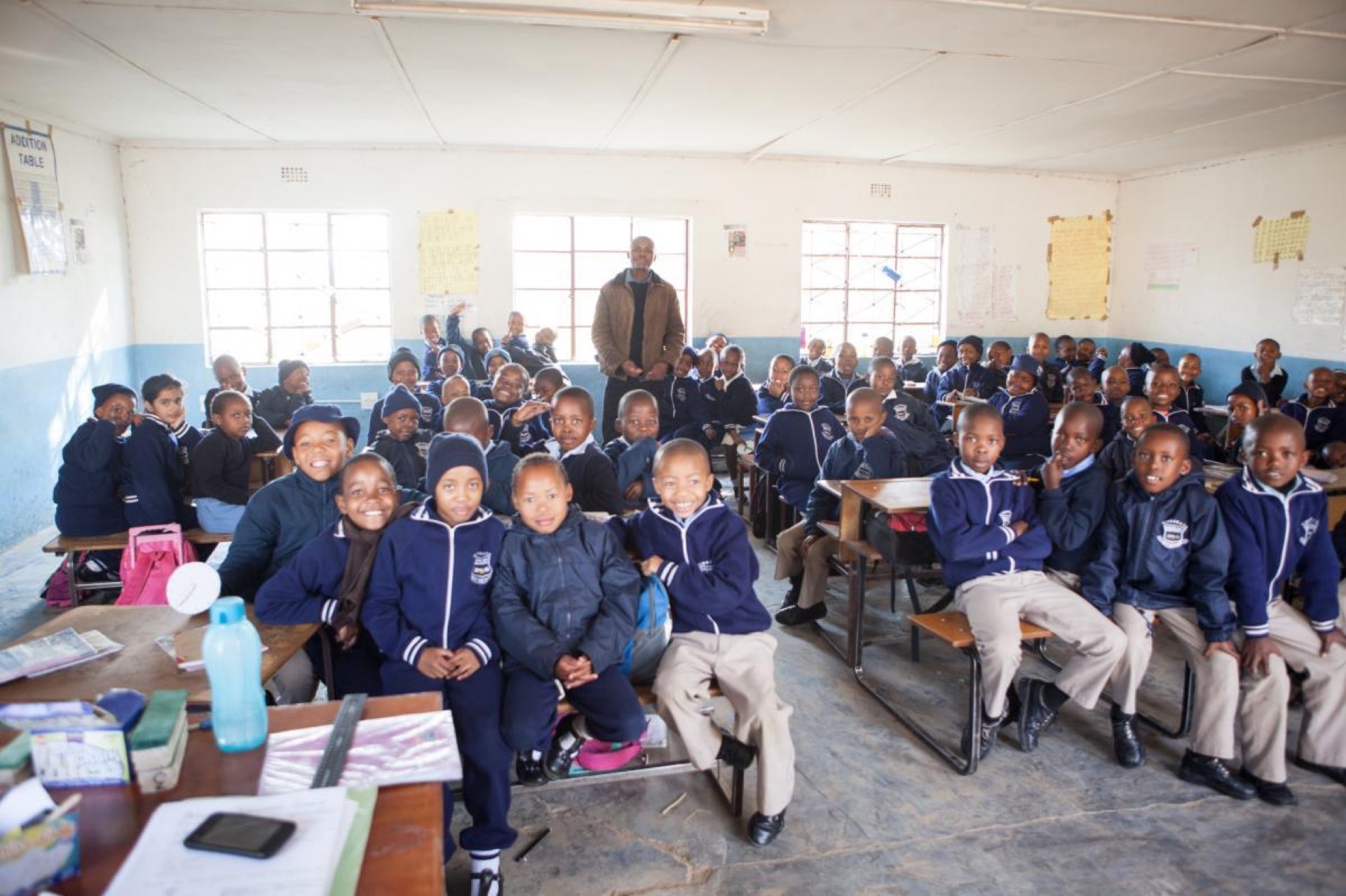
Lesotho is a country caught between its own traditions and Western influence like few others. In towns such as Mafeteng and Maseru, people live very much in the American way. Almost everyone has a smartphone – even the older pupils at Kingsgate Primary School have one. To us it may seem a little strange to be able to do without running water in the house without any trouble, yet not want to live without a smartphone. But that question vanishes into thin air as soon as you realise that, apart from the television – which everyone in the towns here also owns – the phone is the only source of fast information from anywhere. And so phone and television open a window onto the wide, digital world.
In the countryside, hours away from the towns and the densely populated lowlands, things look completely different. The villages and individual herders’ huts are surrounded by mountains over 3,000 metres high and can only be reached on horseback, by donkey or on foot. Few of them lie near the tarred national roads (comparable to German country roads), which have been built in a star shape out from Maseru for some years now with international aid money. The USA played a major role here, providing around 50% of the funds in recent years. That is one reason why enthusiasm about the new US president has been rather “muted” in recent weeks, after Trump announced that “all (African) governments are corrupt” and that he therefore wanted to reconsider development aid, as he wonders how much of the money actually arrives. (“heute”: 22 January 2017)
Corruption is certainly an issue that cannot be ignored, but here in Lesotho you can see how the population really does benefit from international funds once their village has been connected to the electricity grid or the road network – something that could not have been achieved without funding.
Here in the mountains, however, many people are still dreaming of running water or electricity, or even a road connection. There is no connection to the rest of the world via phone or television. Most farmers and herders therefore do not speak English, as is actually common in the rest of the country, because they either never had the chance to go to school or were taught only in Sesotho.
How great the contrasts here in Lesotho are only really became clear to me in the last few weeks – on the teachers’ outing into the sky of the Kingdom in the Sky, to Semonkong, the Place of Smoke.
Our trip began on a sunny Saturday at 7 in the morning at Kingsgate. Barbecue equipment, papa and chakalaka, crates of beer and 14 cheerful teachers were loaded into the hired minibus taxi that was already waiting, and off we went on the four-hour drive from Mafeteng, at 1,800 metres in the lowlands, up into the mountains to over 3,000 metres. Our route took us to Maseru, through untouched river valleys, past traditional villages and over steep mountain passes that we crawled up behind lorries at 20 km/h. Thanks to the sunroof I was able to enjoy this breathtaking landscape as it passed us by. We drove deep into the interior of the country, to where there is no running water or electricity. Deep into the mountains. Past laughing children and herd boys who stood waving by the roadside as soon as they saw our group.
And suddenly it appeared around a bend… One of the most beautiful places I have ever seen in my life: a breathtaking gorge around the Maletsunyane Falls.
I sit down on a rock near the roaring abyss. Five metres in front of me there is a 200-metre drop. Next to me, the others in silence. The swallows, absorbed in their aerial combat with mosquitoes, flies and the like, shoot over our heads. Nature’s black fighter pilots thunder past so close above us that I can feel the draught on my neck.
On my skin I feel the tiny droplets of water rising from the depths and moistening my face. At this moment I want to be nowhere else and never leave this paradise on earth. Nothing can be heard except the never-ending roar and the cry of the occasional swallow. So I simply sit there, oblivious to everything. I feel as if I am in a bubble where no one can reach me. 10, 20, 60 minutes… Time races on without my noticing.
Then I slowly begin to realise that I should perhaps take a few pictures, even if they could never fully capture the beauty of this place.
Friday, 10 March. 5 o’clock in the morning. The alarm goes off. I sit bolt upright in bed. Wide awake. Three quarters of an hour later – actually an hour too early – I am at school, just like most of the pupils and teachers. But instead of pupils I see herd boys wrapped in traditional blankets, girls in extraordinary skirts made of white ostrich feathers, and many a boy and girl dressed in the clothing of the San and the Basotho as it was worn before colonisation. Here and there, too, one of my pupils, smeared with soot and wearing the miner’s uniform of their fathers, who work in the mines of South Africa or did so during apartheid. It is Cultural Day, in honour of the anniversary of the death of the first king of the Basotho and father of the whole nation, Morena Moshoeshoe I.
Cultural Day is always celebrated at Kingsgate Primary School on the Friday before 11 March.
The final rehearsals for the big celebrations starting at 10 o’clock are in full swing. Over the past few weeks every pupil has rehearsed in small groups with their classmates for this one day of the year. Top secret, of course. No one apart from the supervising teachers was allowed to know how the preparations were going.
Then the first performances begin, and I, like the pupils, parents and teachers, am simply impressed by what the pupils have put together.
A few minutes later I find myself wrapped in a woollen blanket with traditional blue patterns, and pupils put a mokorotlo, the traditional Basotho straw hat, on my head.
While some of the Grade 7 girls were performing the traditional dance, Sello suddenly came up to me, took my camera and phone, gave them to the teachers standing next to me and asked me to come with him.
Shortly afterwards I was wrapped in an antelope skin in the midst of the older boys. Sello pressed a stick into my hand, and then off we went with me in the middle of them.
They performed a very special dance, as was explained to me later, about which – despite my unexpected participation – I knew nothing until a few seconds before the performance.
The ritual song and dance was and is performed by Basotho boys who have attended a so-called “traditional school” when they return home. These schools, held on table mountains or in remote valleys far from any civilisation, last a full six months. During this time the boys live apart from their families, only with their fellow pupils and teachers, and learn to become good protectors of their families and villages. No one who has not attended such a school knows exactly what happens there, though, because the secret is taken to the grave. Any outsider who approaches despite the explicit ban, which applies to everyone, is held until the end of the school term and thus becomes part of the community.
But the real meaning of the dance is that with this ceremony the boys are accepted as full members of the Basotho nation. And so, on the anniversary of the death of Moshoeshoe I, the founding father of the people of the Kingdom in the Sky, I became part of the Basotho, if only symbolically. That has been the most moving moment for me in Lesotho so far, and I still cannot put it into words.