

A month has already passed since I set off once again on my African adventure. For the first few days, though, not to familiar Lesotho, but to Cape Town with a friend. Cape Town… a city with as many facets as its inhabitants… so beautiful and so ugly… A city where two worlds collide, where rich and poor live so close together, existing side by side as if thousands of kilometres lay between them, and yet constantly colliding and collaborating. A city that fascinates.
Back in Lesotho, by now my second home, school life began again straight away. On the morning of 25 January I saw for the first time something that in October – indeed until a few moments before – I would never have dared to imagine: the school garden. Or rather, the neatly tended dream of a school garden, cared for by hundreds of hands. Everywhere the most varied vegetables and fruit were growing, from maize, pumpkins, beans and spinach to watermelons. And all of it looked after by pupils aged eleven to 14 throughout the whole summer holidays, without any compulsion or supervision. The pupils had drawn up a work plan for each day, complete with shifts, all on their own. That moment simply made me incredibly proud of “my” little gardeners.
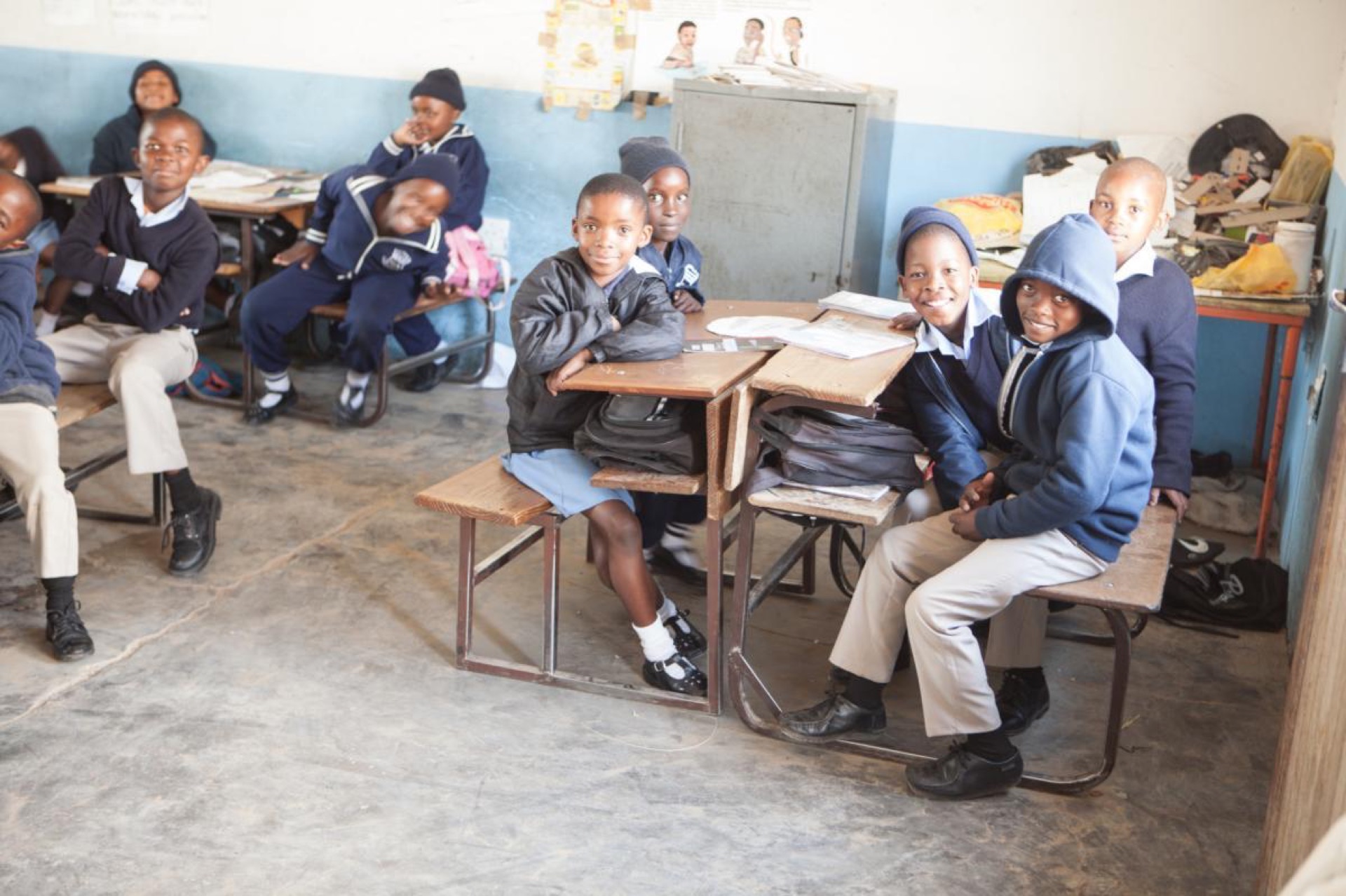
It was and still is simply wonderful to be at Kingsgate Primary School. In the mornings, lessons in Grades 3 to 7, and in the early afternoon, work in the garden (92 pupils) or with the German club, which currently has 10 pupils. After school I passed the time just as I had in the first months. So the last few weeks really flew by.
The visit of two good friends and former classmates from 11 to 19 February also contributed to that. It was a really, incredibly funny, eventful and simply cool week. It rained constantly, but we still went to Thaba Bosiu, hiked in the surrounding area, rode racehorses bareback, went to the school and the garden of course, and thoroughly enjoyed the wonderful taste of Lesotho’s great pride, Maluti beer.
In general it has been raining quite a lot lately… It seems as if Lesotho was a crown colony of the British Empire a few years too long, and not only did breakfast with baked beans, sausages and scrambled eggs catch on, but English weather – famous for its bright blue summer skies – also became established. I am sitting here in a woolly jumper, woolly socks and long tracksuit bottoms, freezing my a** off. So much for summer in Africa. But, as everyone knows, people are always moaning about the weather… 35 degrees and sunshine… “It’s far too hot…”. 22 degrees and days of rain… “It’s too cold and wet”. So I will not complain any further, because on the whole I did rather successfully escape from the end of the German late summer in October into the African summer before the bitter cold set in. And, conveniently, I will return to summer just as winter begins here in July. “Almost 12 months of permanent summer… living the dream,” I could have said three years ago, and according to the dictionaries I would have been perfectly fluent in youth slang.
But I am no longer entitled to throw youth slang around, at least according to the pupils’ estimate of how old “Sir Leif” is: 24–26. My attempts to correct my age (19), however, are regularly nipped in the bud, on the grounds that their older siblings are already 20+.
So in the end I admit defeat and confess that I am in fact 24 and that the date of birth on my driving licence, passport and ID card is wrong – which Hlaks and Moeletsi accept as a satisfactory answer with a broad, triumphant grin. Meanwhile a group around Mpiti and Mahali tries to call what feels like all of my contacts via WhatsApp to try out the German sentences they learned with me in a cover lesson. After a few minutes, when they lose interest, they turn to my photos, commenting on every picture – whether it is a soft-serve ice cream or a breathtaking shot from the plane – with a fervent “Oh” and “Ah”, or they play Candy Crush and so on. And that is what I do apart from gardening in the garden: trying to justify my age and keeping an eye on my phone. But that is exactly what I like so much about the garden: being able to take off the “Sir” and to talk, joke and work relaxedly with the pupils, without the certain distance that exists during lessons.
Monday morning, 10 o’clock, Kingsgate Primary School, Hospital Area, 900 Mafeteng: “Injection Day”
Here we go. Three white Land Cruisers and a minibus, all with tinted windows, pull up in the school yard. Crying children run across the grounds with frightened faces.
Too many parents for it to be normal buzz around from classroom to classroom, chattering loudly, looking for their children. The teachers seem tense; they abruptly break off their lessons; Mateboho Masiu is just evicting three teachers in two buildings from their classrooms. The pupils pack up their things and are distributed among other classes. They all have one thing in common – whether mother, father, older brother or almost every pupil – they are carrying a little yellow booklet, or “bukana”.
On the side of the three vehicles I can dimly make out a blue logo.
Nine men and women with large cool boxes get out of the vehicles. They seem expressionless, faceless even, just as I had imagined the grey gentlemen in Michael Ende’s “Momo”. The only difference: they are wearing white. But then Mateboho walks up to them. Friendly greetings in Sesotho are exchanged. I think I can make out a brief smile. A blink of an eye later, it has already faded.
They spread out into the cleared classrooms and return to their vehicles. Even more boxes are carried into the classrooms. A car door slams shut. And there it is, in large letters beneath the blue globe with laurel wreath and serpent: “World Health Organization”.
The same logo is emblazoned on the hundreds of yellow bukanas.
And then I remember what the nuns at the CTC told me when they translated the news for me last week. Measles and polio vaccinations have been announced at all schools nationwide, led by the WHO and supported by Queen Masenate Seeiso of Lesotho, to fight a feared epidemic directly after the first cases appeared.
These vaccinations, I was told, are compulsory. Anyone who is not vaccinated at school has to have it done at the hospital. And they are free, unlike any other medical treatment in Lesotho and South Africa, which always has to be paid for directly. A health insurance system like the one we know from Germany or the rest of the EU does not exist.
After the doctors and nurses had set up their classrooms, the children were vaccinated class by class, from pre-school upwards. A new sterile syringe was used for every pupil – sadly not always a matter of course in Lesotho – and was then disposed of directly in a sealed bin labelled “biological hazard”.
Meanwhile I was busy marking the vaccinated children’s fingernails with a special pen that is supposed to last until the vaccination campaign is completely finished.
As it turned out, my first impression of the doctors and nurses was completely wrong. For these men and women do not steal time at all, as the grey gentlemen did – they give time. Time that children can spend playing with their friends, learning and living their lives, instead of being seriously ill.
This day impressed me enormously. While in Germany we can afford the luxury of musing about whether vaccinations make sense or not, elsewhere in the world children still suffer all their lives from diseases that really should no longer exist. In recent years, under the queen’s leadership, not only have health care and vaccination coverage improved significantly. The number of new HIV infections has also been falling steadily since 2005, four years after her marriage to King Letsie III and the start of her work. (2005: 30,000 new infections; 2015: 18,000 new infections (UNAIDS reports 2014/15/16)). The figures are still the second highest in the world relative to population, but there is a clear trend. In so many places you notice that everything is being done to fight HIV and other diseases: in the airport toilets (free condoms), vaccination campaigns, awareness programmes by the WHO, the US Peace Corps and the government, and constant advertising campaigns on state television.
On the other side of the globe, the rich side, measles recently broke out again on a large scale in Berlin, because parents refuse to vaccinate their children for ideological reasons, thereby also endangering the lives of children who cannot be vaccinated. But that is probably what you call a “first world problem”.
With these very different impressions out of Africa, I wanted to get in touch again after another month of adventure in Lesotho. Part of the reason for the long silence was that the internet at Kingsgate Primary, which I usually use to upload my blog posts, was down for several weeks.