

Lumelang,
Today we are back in touch from Mafeteng, both to tell you about what we have experienced over the past few weeks and to share a few stories that have happened here.
What has been happening…
Opening of the library
Last Wednesday we opened the newly stocked and organised library. Of course, we could not resist celebrating it a little. We went to school early and hung up balloons. The pupils realised straight away that today must be something special, and as soon as they saw the balloons they stormed towards the library. But everyone had to be a little patient, as we only let the pupils in class by class.
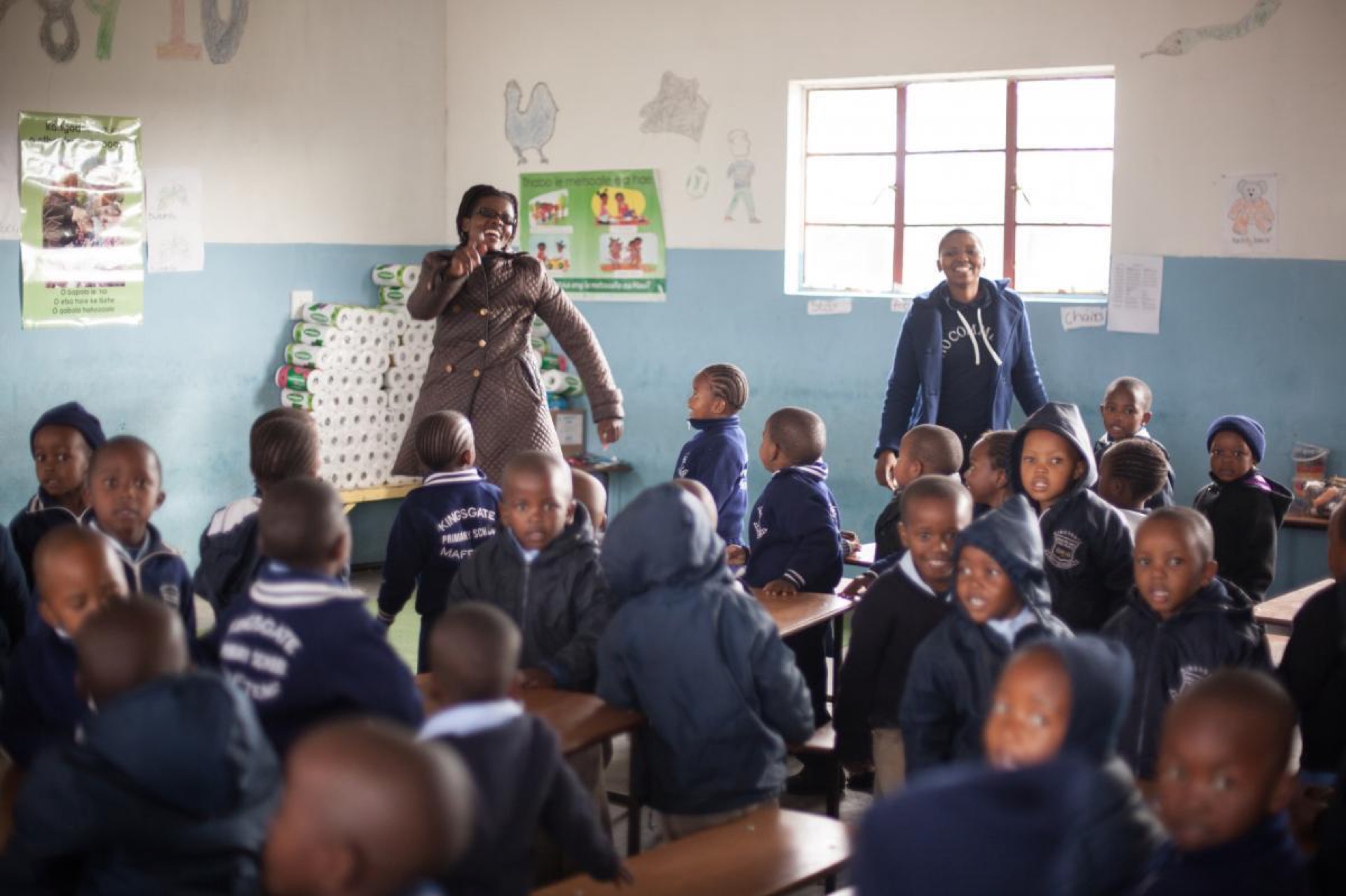
We started with Reception (pre-school). After an introduction on how to behave in a library, each child received a learn-to-read book from us. The real problem only dawned on us when 120 five-year-olds were supposed to whisper and mumble their names – which, well, all sounded very similar to us – so that we could enter them in the list. We had not considered that a child might neither know nor be able to spell their surname. It was a funny situation, but also a very lengthy procedure, so first the principal and later another teacher stepped in to help. From Grade 3 onwards, though, it was no longer a problem.
It was lovely to see how happy the children were to be able to borrow a book, and their shining eyes more than made up for three weeks of very monotonous sorting work in the library. The funny thing was that some Grade 1 pupils accidentally tried to borrow a book twice because they had been sent to the library twice.
Some older pupils have already ventured into proper page-turners or non-fiction books. We hope to get the books back in reasonable condition and actually read – let’s see how that works out.
All in all, the library opening was very exhausting, but a great day for us, because we really felt that we had created something big here. We could not help smiling when we saw children at break time sitting in the classroom absorbed in their books, simply content, instead of romping around wildly.
The teachers were also delighted with the opportunity now open to the children. Ms Masiu, the principal, told us later that reading is important here too for preserving the culture, and that, much as in Germany, reading culture is dying out more and more due to the influence of smartphones and TV. Here in Lesotho in particular you really notice the contrast between simple cultural life and the modern world.
Even today, a week later, when the children returned their books, the joy had not faded. The pupils told us enthusiastically that they had read the book with their mother, father, brother or grandfather.
From now on we will open the library every Thursday and Friday for the whole morning and, class by class, give every child a book that they have to bring back the following week.
Cultural Day
Once a year, on the birthday of Lesotho’s first king, Moshoeshoe I, there is a public holiday weekend in Lesotho. Kingsgate Primary School always holds a very special day then too, the so-called Cultural Day. Our predecessor Leif Habermann had already told us enthusiastically about this day. But what awaited us on 8 March 2018 is very hard to put into words.
About a week in advance, everyone was already full of joyful anticipation and excitement. The pupils were eagerly practising and rehearsing – some in secret – their dances and plays for the day. It seemed as if school was just a tiresome side issue. Everyone asked us what traditional clothing we would be wearing. We had no idea, though, and thought we would just come in our normal clothes, until the day before, when a teacher stood in front of us with a mysterious plastic bag and, after we had caught a quick glimpse inside, introduced its contents as our traditional outfit. We had a faint suspicion that it could not just be a costume in the form of an ordinary dress, but something more revealing.
When we walked to school on the day itself, we were greeted by a colourful and fascinating sight. All the pupils, whom we otherwise only know in their school uniforms, were wearing colourful dresses, skirts, necklaces and blankets in every conceivable colour and combination. There was not just one traditional outfit but many different ones. Every single child was laughing, dancing and simply happy and proud to show us their tradition and explain it. Even if you think you come from a traditional village, you quickly realise here that culture and tradition are lived much more intensely and in more varied ways – even by the youngest. The children could tell whole stories, for example about the necklace they were wearing. People danced and played in large groups, and of course we took loads of photos! The usual Morning Assembly was also a good deal more colourful and relaxed than normal. After the assembly nobody thought of going into the classrooms; instead the dancing and singing went on until the BEAT started and all the children suddenly sprinted off to a big open space in front of the school. We just stood there, stunned, but then decided to head towards the music too. We will probably never forget the show we were treated to there. You will not experience anything like it in a German club or at any festival. Around 1,000 children, jumping and – really – dancing incredibly well, going completely wild to the sound of the music. It is worth mentioning that a DJ with a massive sound system had been hired especially for this big party. Don’t forget – for children aged between 3 and 14. The music, we discovered, was exactly to our taste: African electronic music mixed with a few chart hits. The biggest danced with the smallest, and somehow everyone together. There was an exuberance and joy we had never experienced before.
When the DJ stopped the music, to the children’s great disappointment, the official part began, in which each class performed something traditional – a dance or a play. The children were almost bursting with pride after their performances, and we also picked up a great deal of Basotho culture, even though the whole celebration was held in Sesotho. During the ceremony we were suddenly taken aside to put on our traditional clothes. As we had suspected, it was the thethana – the earlier, let’s say Stone Age-like, clothing of the Basotho, consisting of a very short leather skirt, a leather top and a kind of apron over the backside. Our faces were also decorated in the traditional way (which in the modern world means our eyes were outlined with Tipp-Ex). Dressed like this, we stepped into the middle of the circle of pupils and danced a traditional dance together with three teachers and pupils “dressed” the same way. And so, after seven weeks in the country, we were officially accepted into the Basotho nation – a people who see themselves as a large, proud community with a long history and tradition, even though the country is very small and the nation still very young.
Traditional food was cooked during the celebrations: bread from the pot, moroho (similar to spinach), pumpkin, corn on the cob and bean-and-maize stew. After the festivities, once each dish had been presented individually, everyone ate together with the pupils. The party with the DJ then went on for a few more hours.
After three hours of dancing everyone was very, very hungry
At the end of the day every child, every teacher and we too went home tired, happy and very content.
The whole celebration felt like an escape from everyday school life, from daily problems and from the modern world. It was marked by pride in one’s own country – a pride that is as normal here as anything else. A pride that every child already carries within them, that they let us feel and that they include us in.
…you can find many more pictures in the gallery.
Lesotho is when
Now to a topic that has come up again and again during our time here. It is a topic that shows how different Lesotho and the Basotho are compared with Germany and the Germans.
Lesotho is when
almost every shop is open on Sundays and everyone spontaneously does their weekly shopping after church.
it rains while the sun shines from what is actually a blue sky. And the baby-blue sky, ten minutes after an apocalyptic thunderstorm, looks again as if nothing had ever happened.
your neighbour decides at seven in the evening, in complete darkness, to walk into town wrapped in a fluffy blanket (pink-purple-white-green striped) to quickly buy breakfast for the next morning.
some teachers, although they work twice as much as the lazy teacher in the room next door, do not earn a cent more.
the internet, despite constant 4G coverage, does not work on Friday and Sunday evenings, because at that time what feels like every Mosotho is online and the network is badly overloaded.
with every (daily) thunderstorm you just wait for the power to go off – which then reliably happens almost every time. Even when you are in the middle of cooking dinner.
nobody really fills up their car when it is empty; sometimes there is simply no fuel in the tank to drive further than the petrol station, so you cannot just drive somewhere on a whim.
the biggest sports shop in the country is the size of a kiosk and you can still get everything a German sporting heart could desire.
women at the roadside sell roasted maize from home-made grills every day (for 70 cents), even though it is 30 degrees.
you cannot get beer, wine etc. in the supermarket, only in a separate liquor store.
the whole of life comes to a standstill because of a rain shower (no child comes to football training, some do not come to school and certainly nobody goes to the gym).
every child can knit and you often see them simply getting out their knitting when they are bored.
the only day on which no child has to go to school is not Sunday but Moshoeshoe Day (at high school pupils go to school on Saturdays and Sundays too).
girls ask you for a selfie in the street just like that, simply because they have probably never been in a picture with a white person but would find it “super cool” (we will never feel this famous in Germany again).
your football players come to training in skirts and jeans despite repeated reminders and explanations.
Little stories from the kingdom
Between thousands of books and a thousand pupils in the library
We believed, and still firmly believe, that it is 100% necessary to give every child a new book every week in order to create a kind of reading routine. What you forget, however, is what a utopian mammoth task it is to rush a thousand pupils through the library in two days. It is unbelievably exhausting, but the stress is worth it.
The story of the cheated taxi driver
Not getting ripped off even though you are white – that is our mantra. In a country where anyone who is not dark-skinned is either a tourist or a Peace Corps volunteer from the USA, you really have to be careful not to pay twice as much for the tomatoes at the stall or the ride to Maseru, as the locals kept confirming to us. They explained to us in detail what things cost – a roasted corn cob (R10), a banana (R3) and also a taxi ride within town (R6.50) – so that we would be prepared for anything. With this confidence behind us, after shopping one day, too lazy to walk home with our full bags, we headed to the taxi rank. Full of motivation, we went to the first taxi that looked halfway roadworthy and asked how much a ride home (2.5 km) would cost. The driver thought (a little too long) and then said casually: “R40”. Unable to believe it, we asked twice more whether he really meant forty. He confirmed it again and did not react when we tried to make clear that we knew perfectly well this was far too much. By taxi driver number two, slightly annoyed by now, we thought: we are not that stupid any more. We asked again how much a ride would cost. Taxi driver two also seemed to be considering how cheeky he could be. Then he said: “R20”. That is still far too much, we thought. We had no desire to be talked into it like stupid tourists, but no desire to walk home either. So I said: “We know that’s too expensive – we’ll come for R10.” The driver agreed and took us, together with other passengers, straight home. When we got out, we pressed the 10 rand into his hand and were almost a little proud of ourselves.
That evening, when we proudly told a friend about it, he just said: “You only gave him R10? You do know it’s R6.50 per person, so R12?” It hit us like a bucket of cold water – we had completely forgotten that in our calculations! He grinned: “So you ripped him off!” To this day we do not know whether we should be ashamed or just laugh about it…
The substitute teachers
It is Monday. After a relaxing weekend, Clara and I walk into the Grade 6 classroom highly motivated and perfectly prepared, because we have the German club there after school. It is 13:04, so high time, and fighting against the great commotion we start wiping the board to make ourselves noticed. We can hardly see over the big crowd of pupils leaving, still writing or running around, and are just about to throw out everyone who is not taking part in the German club so we can finally get started. Then a pupil asks Clara: “So we’ll do the sports club tomorrow?” Clara comes storming into my classroom, slightly stunned, and says: “Erm, Hannah, isn’t it actually Monday today, and therefore sports club???” The wheels in my head start turning and we realise: damn, we really got things completely mixed up! Normally Monday is sports club and Tuesday is German club. We search feverishly for a way to save our otherwise perfect weekly club schedule without completely confusing the pupils. Without hesitation I sprint across the school grounds, fetch cones, balls, bibs and – very important – relay batons, and quickly throw on my sports kit, while Clara gathers all the children and guides them to the sports ground. Then I run onto the field and set up the exercises at lightning speed while Clara does the warm-up. It is 13:15. Then the relay race starts, in which the class even runs its best time. At the end we explain the final group game as if there had never been any other plan for the day. Our honour is saved, almost nobody noticed anything, and we are almost a little proud of our spontaneity. The Basotho have probably rubbed off on us a bit already.
The WhatsApp message
It is ten o’clock on a Sunday evening and we are sitting relaxed on the sofa reading when I get a message. It is from our neighbour and simply says, very matter-of-factly: “No water for the next two weeks.” Slightly shocked by this statement, we think feverishly about what it could mean, even though logically it is obvious. We try to convince ourselves that the message means something completely different and much less bad. A little later our neighbour comes over and explains in great detail that cleaning work is being carried out and that the whole town will therefore have no running water for up to two weeks.
Questions race through our heads: How do we cook? How do we wash? How do we shower? And how on earth do we go to the toilet? Of course, here in Lesotho, where many people never have running water at all, there is a very simple solution to all these serious problems. You use the school’s pit latrine (only 100 m away), and showering, washing and cooking are done with water fetched in buckets from the school’s rain barrels.
It all seems very logical and simple, and yet our mood is very subdued as we take our last shower, and the next morning really no more water comes out of the tap. It is tiring to keep pouring everything from one container to another, to wash your hair with water from bowls and to have to run to the pit latrine every time, even in the dark. We got the full experience one day when the power also went off for longer than usual and we really felt as if we had been sent back to the Stone Age. All we hear from locals is: “You’ll get used to it.” And astonishingly, many people do not even notice that there is no water. And indeed, after three days we had got used to the change. To our great surprise, though, the water fortunately came back on the fifth day, as the cleaning crew had apparently hurried. We were as happy as little children, relieved, and enjoyed the luxury when the water – albeit still slightly milky – came out of the tap. In any case, we are one experience richer.