

Our journey to a country that – like most Europeans, probably – we had never heard of before planning the trip a full two weeks before departure (which, as we learned from various sources, counts as extremely early planning for Peter Krimmel) began on Sunday 15 May.
Around midday we drove to Frankfurt Airport, not yet suspecting what breathtaking impressions and experiences we would gather over the next week.Of course – as befits German tourists – we had tried to inform ourselves thoroughly about the culture and sights with the help of travel guides. This turned out to be harder than expected, because seemingly every German-language guide with a title like “South Africa, Lesotho and Swaziland at a Glance (300 pages)” has at most five pages on Lesotho, about three of which warn of the wildlife – very boring compared with South Africa – and of monuments covered in graffiti. So much for getting information in advance the traditional way. On the internet we did find more detailed information about the culture, the landscape and so on. But we still had no real idea of what awaited us in this country.
At the Frankfurt security check and the obligatory body scanner it was a quick “Smile, please”, and then, after a beer at an airport bar, off to the seats – about the size of a sheet of A4 paper, or so it felt – that we could call our own for the next eleven hours. Any attempt to sleep was thwarted by the crew for all economy passengers: on the one hand by a firm grip on the shoulder that would make even Israeli Krav Maga fighters turn pale, combined with the question “Scrambled eggs or continental breakfast?”; on the other hand by a spirited flight attendant who used her trolley as a kind of medieval battering ram to push the heads of sleeping passengers – including Elisabeth in her aisle seat – out of the aisle. The only one who remained unfazed and slept peacefully through it all was Elisabeth.
At around 7 o’clock the next morning, completely exhausted, we were standing 8,600 km from home in the middle of Africa at passport control at Johannesburg airport – or O.R. Tambo, as almost everyone in southern Africa calls it.
After security it was time for some early-morning exercise, almost including a sprint. Our goal was to reach baggage reclaim and the customs check before the passengers from the Dubai and Hong Kong flights (all of them large families with what felt like more than twenty members).
With our hand luggage and our trekking backpacks wrapped in plastic film – a must when flying to Johannesburg (to prevent theft) – we hurried to our car rental company. In our rental car, a Toyota whose engine sounded and drove more like a lawnmower than an automobile, we set off on the adventure of African traffic, complete with driving on the left, people and animals on the road and potholes metres deep – which, however, did not stop Elisabeth from drifting off into the land of dreams for most of the journey.And then, after a six-hour drive and more than 24 hours of travelling, we had reached our destination. Lesotho, “the Kingdom in the Sky” – which is meant literally, as it is the highest country in the world in the sense that no other country has its lowest point as high up, at over 1,400 m – welcomed us at Van Rooyen’s Gate (the border post).
Barely arrived, we drove another 20 kilometres along roads much better maintained than in South Africa, straight to Kingsgate Primary School in Mafeteng, where in the afternoon the principal, Mateboho Masiu, welcomed us more warmly than we had ever experienced from a complete stranger. This warmth was no exception, though – as we realised over the next few days, it comes naturally to the people of Lesotho.After getting a first impression of the school, we turned to the actual purpose of our trip: planning Mateboho’s stay in Germany.
After a relaxed dinner with Mateboho and the school’s computer specialist, Zelo, we fell into our beds dead tired at the Catholic Training Centre – simple but surprisingly comfortable and, like all the houses we saw, clean. And for Elisabeth the icing on the cake of our stay: a bathtub!Still tired, we set off at six the next morning at dawn with Mateboho on the hour-and-a-half drive to Bloemfontein, South Africa, to apply for Mateboho’s visa, which turned out to be more difficult than expected despite having all the necessary documents. There is a German embassy in South Africa, but it does not handle any visa applications; that is done by an agency called VISALink, which apparently knows even less about issuing visas than most of us know about quantum physics. In the afternoon we met Leonmore, a very good friend of Dr Krimmel and a member of staff at KAGISO LAP.
We spent the following days in Lesotho until our return trip to Johannesburg. With the formalities now taken care of, we could turn to the really interesting things such as people, nature and culture.
On Wednesday we were at the school during lessons for the first time. We also spent a complete school day there on Thursday, from start to finish, and Friday until half past eleven.
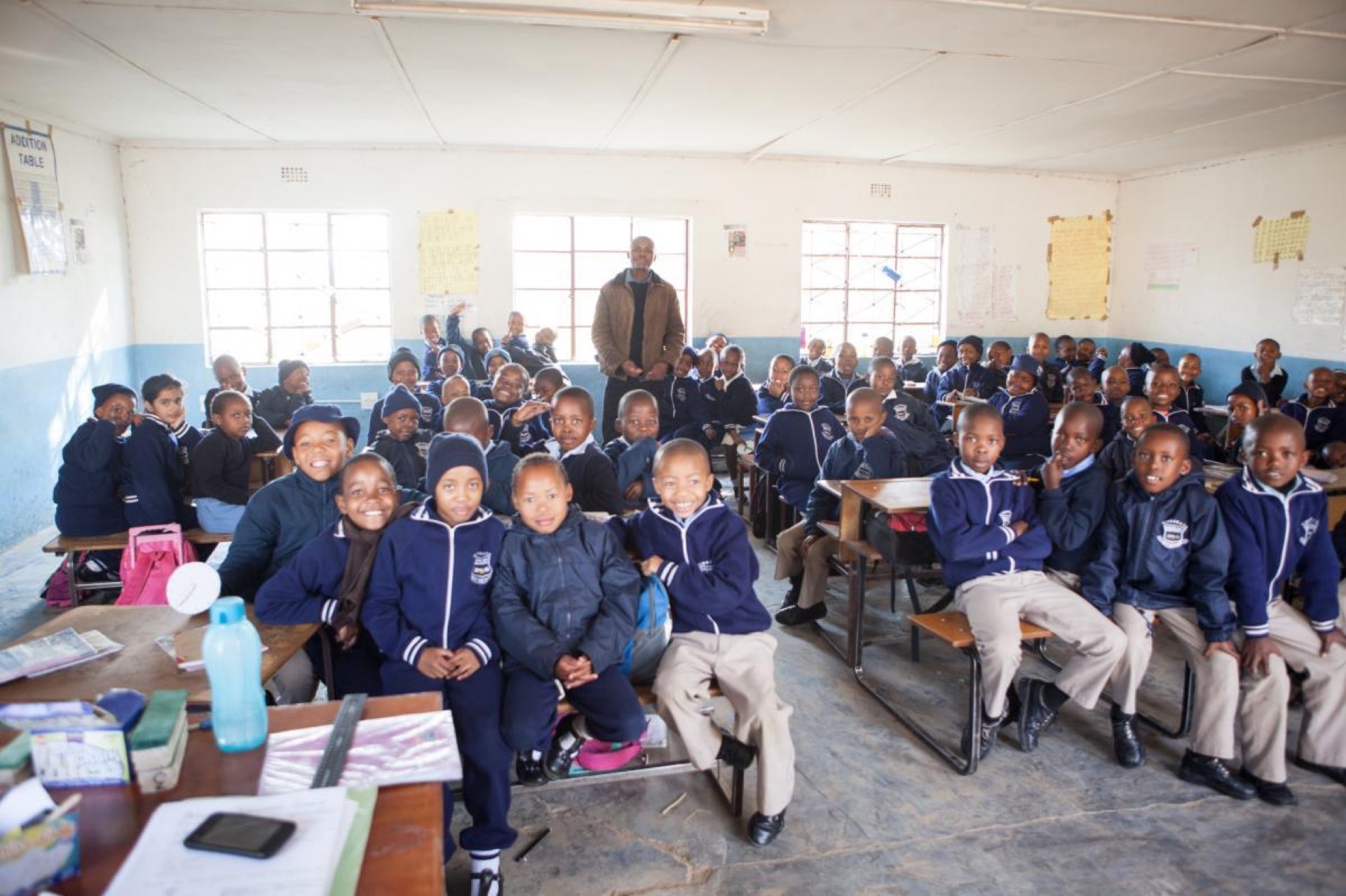
At break time the 900 pupils stormed into the playground after the mobile human school bell – who ran beaming across the school grounds with her best friends – and became absorbed in skipping and hopping games that we never understood despite watching for a long time. The pupils also spotted Elisabeth’s camera immediately. And that was that: surrounded by children who wanted to be photographed and shook our hands, we spent every break in a cluster of beaming children. We will probably never forget the children’s radiant, open-hearted smiles.
During lessons the pupils seem like different people. Despite 70 pupils per class in a room the size of a small German classroom and only one teacher, there is complete silence. The pupils of Kingsgate Primary School soak up every single word of their “teacher” with an eagerness to learn that we have never experienced in a German school. It seems as if they all know from Grade 1 onwards that their whole future depends on what they learn now, whereas German pupils are usually more interested in the next long break.
And we took the same impression away from the whole teaching staff. We have very rarely seen as much dedication as the teachers of Kingsgate Primary School put into education and therefore into the future of every single one of their pupils.Together with the whole staff of 22 teachers – for more than 900 pupils – we also visited the local radio station in Mafeteng. After a tour of the office and the small recording studio, which was very modern and brought up to “Western standards” (if there is such a thing for radio stations), we learned that we now had to face a spontaneous interview of “only” 30 minutes, broadcast live. Note: radio presenters in Lesotho have very penetrating voices.
Our radio visit was on Wednesday. In the evening we were already looking forward to dinner at the Catholic Training Centre, unlike Monday and Tuesday, when we had eaten at the Mafeteng Hotel and at a snack stall on the main road. After two days of chips you are glad to have rice, salad, vegetables and – in my (Leif’s) opinion – a brilliant beef ragout.
So we ate with the nuns at the CTC on the following days too. The entertainment was also much better – probably unique and very unusual for Europeans. Or have you ever heard a nun sing the hit “Work” (Rihanna)? But in our opinion it is exactly this moment that shows the lightness and joy of life of the Basotho, which we saw everywhere on our trip and from which we could all learn something.Another highlight was our excursion on Friday to the national monument of Thaba Bosiu. Even the journey there with almost the whole staff in a minibus typical of Lesotho was an experience in itself. As there were not enough seats for everyone, a school bench was simply put in the aisle, people held on, and off we went with loud music from a Pioneer sound system that seemed far too big for the bus.
Our destination was the table mountain Thaba Bosiu, in the west of the country near the border with South Africa. Here Moshoeshoe I defeated the Boers and drove them back beyond the borders of today’s Lesotho. This was the most important moment in Lesotho’s history, as it allowed Moshoeshoe I to protect the Basotho from the terrible apartheid.
And this legacy can still be felt today. We did not notice in Lesotho the tensions between the white and black populations that have not yet been fully overcome in South Africa. That is probably also because there is no white population with Lesotho citizenship – only diplomats, volunteers, tourists and so on.
But it is not only the history of this mountain that is impressive. The landscape of Lesotho, which you can survey from the table mountain with its incredible view, is simply breathtaking. To the west you see Lesotho’s lowlands at 1,400 m; turning east, you can make out the rugged green peaks of the Drakensberg, over 3,000 m high, with more table mountains cutting through the plain in between. And looking towards the Drakensberg, at the foot of Thaba Bosiu, lies Mount Qiloane, whose shape found its way into Lesotho’s flag as a hat – the only souvenir we saw and bought in the whole country.
On our way back – once again completely overloaded because of several tightly packed school benches – we were stopped by the police. A grim-looking officer came to the driver’s door to ask our driver why he was carrying too many passengers. But when this nice gentleman looked into the passenger cabin, he saw only passengers sitting on the seats, carrying empty school benches. The other teachers had disappeared, giggling, under the seats and – through the sliding door – into a farm’s outhouse standing at the roadside.
After a brief discussion and the payment of an unknown sum of money – we did not understand a word, as they spoke the local language, Sesotho – we were allowed to continue with all our passengers.
We ended our last evening with all the teachers in a very pleasant gathering over dinner at the Catholic Training Centre.And the next day we were already on our way back to Germany. After a warm farewell from Mateboho Masiu, seven hours in the car, two and a half hours at the airport, an eleven-hour flight, one hour at the airport and two and a half hours in the car, we were back in our orderly lives.
We brought back many new impressions and a different view of what really matters in life, and we also made decisions about our own futures.
Anyone who has been to Lesotho will never let go of this country – or of the whole continent of Africa.
One thing we can both say: we will be back.
Leif Habermann – school leaver, Kolleg St. Sebastian Stegen